

Project Info


Project Description
Robotic for rehabilitation and assistance:
focus on person with disability from research to clinical practice
October 1st 2018
9:30-18:00
Tensile Structure at the Arsenali Repubblicani
Organiser: Stefano Mazzoleni, PhD, The BioRobotics Institute, Scuola Superiore Sant’Anna;
Head, Rehabilitation Bioengineering Laboratory
Email: stefano.mazzoleni@santannapisa.it
A better understanding of the neurophysiologic mechanisms underlying motor and cognitive recovery after neurological impairments (such as stroke and spinal cord injury) has led to the development of innovative rehabilitation strategies and tools that incorporate key elements of motor skill re-learning such as intensive training involving goal-oriented repeated movements.
Robotic devices for the upper limb and gait are increasingly used in rehabilitation: several studies have demonstrated the effectiveness of these devices in reducing motor impairments, but only limited evidence has been found on the improvement of upper limb and gait function so far.
Other studies have investigated the effects of combined approaches that target muscle recruitment (e.g., functional electrical stimulation), neural activity modulation (e.g., noninvasive brain stimulation) and motivation enhancement (e.g., Virtual Reality) in an attempt to enhance the benefits of robot-assisted training.
During the workshop an overview of the current status of robot-assisted therapies will be discussed.
A public debate on the effects of scientific research, clinical practice, healthcare policies and technological transfer on the improvement of quality of life of persons affected by motor and cognitive impairments following neurological diseases will take place.
Then a second part of the public debate will be focused on the bioethical implications of human empowerment due to the use of robotic devices and bionic parts will take place.
Finally during the afternoon demonstration session persons will have the opportunity of using and interacting with real robots for rehabilitation and assistance.
Program (draft)
9:30 am – 9:50 am Antonio Frisoli, Robot-assisted rehabilitation in post-stroke patient using exoskeletons and virtual reality technologies
9:50 am – 10:10 am Stefano Mazzoleni, Robot-assisted rehabilitation treatments for persons with stroke and spinal cord injuries
10:10 am – 10:30 am Irene Aprile, Clinical experimental trial for upper limb robot-asssited rehabilitation
10:30 am – 10:50 am Enrico Castelli, Scientific evidence of effects of robot-assisted rehabilitation in pediatric age
10:50 am – 11:30 am Maria Chiara Carrozza, Challenges of robotics for rehabilitation and personal assistance
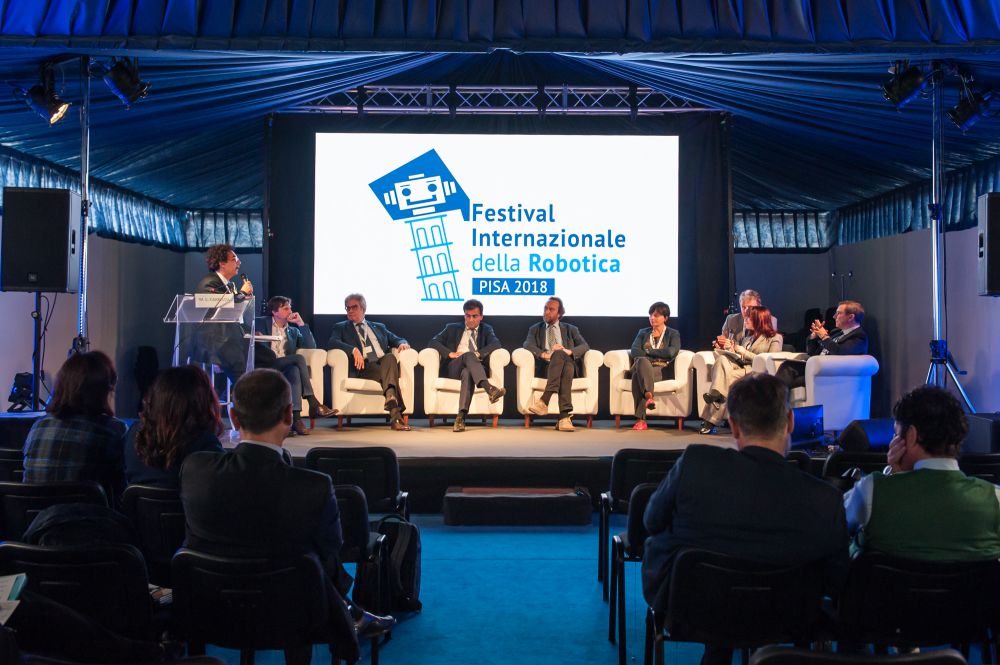
11:30 am – 1:30 pm Discussion on impact of robotics for rehabilitation and assistance on society – Moderator: Daniel Della Seta, RAI journalist
Session 1: Improving quality of life of persons with disabilities: scientific research, clinical practice, healthcare polizie and technological transfer (11:30 am -12:30 am)
Speakers:
- Maria Chiara Carrozza
- Kinda Khalaf
- Federico Posteraro
- Giuseppe Turchetti
- Lorenzo De Michieli
- Enrico Castelli
- Carlo Biasco
Session 2: Bioethical implications of human augmentation and empowerment (12:30 am-1:30 pm)
Speakers:
- Alberto Carrara (UNESCO Chair in Bioethics and Human Rights)
- Maria Chiara Carrozza (Don Gnocchi Foundation)
- Kinda Khalaf (Khalifa University, Abu Dhabi, United Arab Emirates)
- Giulia Stampacchia (ASL Tuscany North-West)
- Salvatore Cimmino (Swimming in the seas of the globe)
- Giovanni Asaro (INAIL)
1:30 pm – 2:30 pm Lunch
3.00 pm – 4.30 pm : Demonstration of robotic devices for the rehabilitation of the upper limbs
4.30 pm – 5.00 pm: Salvatore Cimmino, Video “Swimming in the seas of the globe”
5.00 pm – 6.30 pm: Demonstration of robots for path rehabilitation and assistance
Scientific Committee:
Maria Chiara Carrozza
Alberto Carrara
Stefano Mazzoleni
Faculty: